
We packed our bags and rolled out of Kaza early, watching our beloved homestay shrink in the rear view mirror with a distinct pang of nostalgia. Kaza had been our anchor, our oxygen sanctuary, and our provider of hot meals.
Leaving it behind felt like cutting our safety rope; from this point forward, we were heading into the uninhabited, wild highlands of Spiti, where there are no permanent settlements, no concrete walls, and absolutely no margin for error.
- Chicham Bridge: Suspended over the Abyss
- Losar Again
- The ascent to Kunzum La
- Kunzum La
- Framed by Giants: Photographing the Ice Mountains
- Descending to Chandrataal
- Chandrataal
Chicham Bridge: Suspended over the Abyss
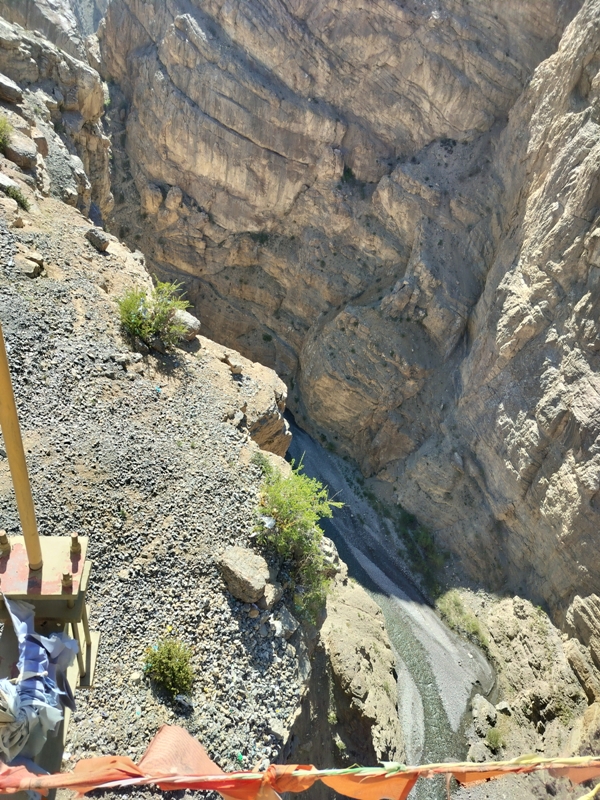
Our first major milestone was Chicham Bridge, whose claim to fame is that it is the highest suspension bridge in Asia. By the time we reached, that claim certainly seemed to hold water. The bridge was a spectacular feat of engineering suspended at a jaw-dropping height of 13,596 ft. It spans a massive, terrifyingly deep gorge that cuts through the stark stone cliffs.
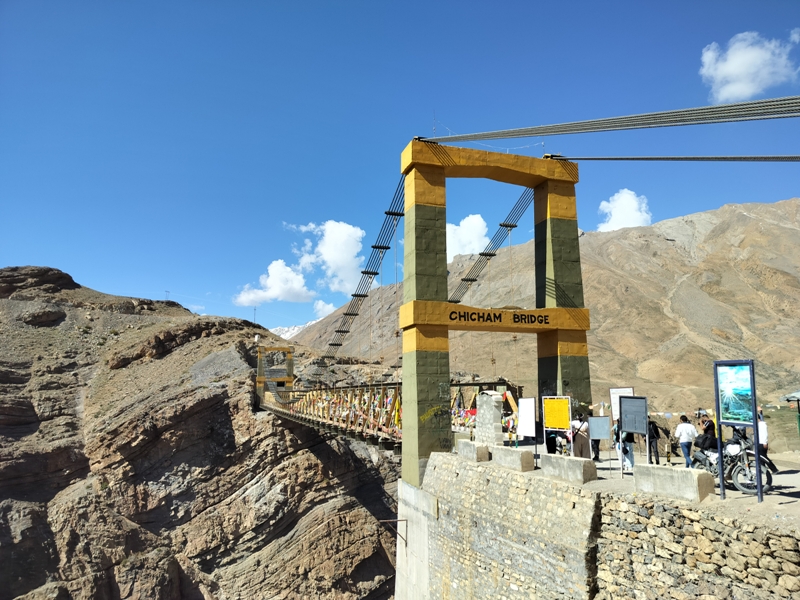
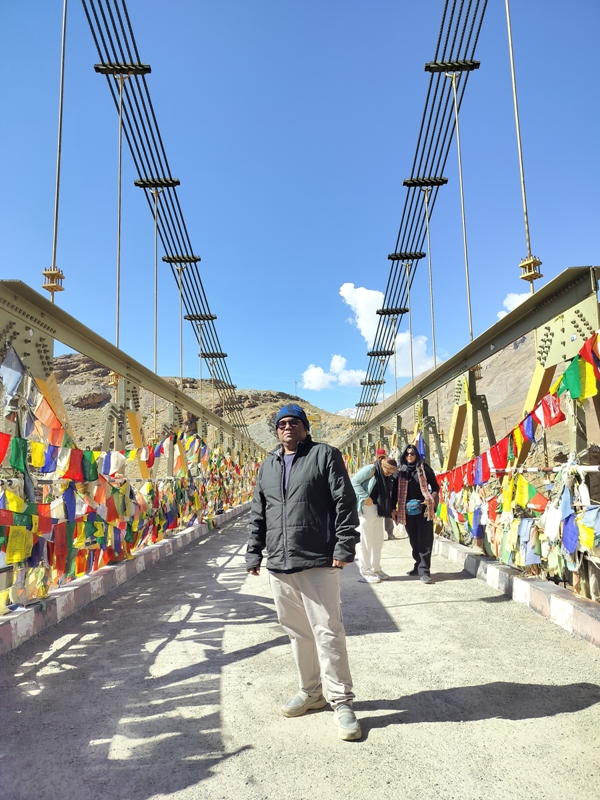
Stepping out onto the narrow metal bridge was an experience in itself. The wind hit us like a solid wall, the bridge swaying up and down every time a vehicle crossed it. Looking straight down, through the metal railings was nerve tattling, the absolute emptiness of the chasm gave us an instant, stomach-churning hit of vertigo.
It felt like we were walking on thin air, a tiny human speck caught between two massive mountain walls. We walked across slowly, listening to the metallic thud of our boots echoing over the abyss, completely awed by the sheer scale of the landscape.
Losar Again
Once we crossed Chicham, the landscape began to stretch out into the high, wide valleys leading northwest. Before we could even think about tackling the mighty Kunzum Pass, both our vehicle and our bodies needed a massive energy injection. That brought us to Losar—the last major inhabited outpost on this side of the pass.
We were driving into Losar for the second time, and both the times the feeling was completely the same. On Day 1, it was an intimidating gateway, into the unknown, punishing highlands; on Day 3, it was a again serving as an entry point for Chandrataal, which boasts of having one of the scariest road in the country.
The meal we had there was a masterpiece of simple, heavy Himalayan cooking. We crowded around tables and ordered magii, parathas and tea. There is an unwritten law of the road that says food tastes twice as good when you’ve earned it, and after surviving the highest tracks in the country, that simple lunch felt like a feast fit for royalty. There is absolutely nothing beyond Losar, so we packed a few more Aloo Parathas for the road, but this time those were neatly tucked inside a bag and not relegated to the last row of the Traveller.
Pushing through the police check-post just outside the village, we took one last look at the whitewashed mud houses of Losar. We were officially leaving the high kingdom of Spiti behind, and along with that our cell phone network.
No connection with modern word for the next 26 hours.

The ascent to Kunzum La
The stretch from Losar to Kunzum La is where the road dropped all pretense of being a highway and transformed into a brutal, gravity-defying mountain ledger. Grinding through the tight, unpaved hairpin bends, the altitude spiked violently, scalling thousands of feet in a matter of minutes. The air thinness catches up to the engine instantly, we can hear it groaning in first gear, gasping for the same oxygen our lungs were scrambling to find.
The drop-offs alongside the narrow gravel track became staggering, looking down into a vast, empty riverbed that shrink with every loop we conquered. The landscape shed whatever green it had left, turning into a stark, monochrome world of raw shale, loose rocks, and towering snow-capped walls that felt close enough to touch.
The freezing wind began to whistle through the windows, carrying the scent of pure glacier ice. It is a white-knuckle, adrenaline-fueled climb where we were entirely hyper-focused, watching the mountain walls close in around us until we finally broke through to the roof of the pass.
Kunzum La
Sitting at a majestic 14,931 ft, this high mountain pass was the geographic gateway connecting the Spiti Valley to the Lahaul Valley. Following local tradition, our vehicle circled the shrines to seek safe passage before we stepped out to breathe in the raw, majestic silence of the roof of Himachal.

Our focus was immediately drawn to the center of the pass, where the collection of ancient Buddhist stupas stood proudly against the elements. The stupas were surrounded by vibrant prayer flags, that whipped and snapped violently in the gale-force winds, a sound that resembled the roaring applause of the mountains themselves. Standing close by is the temple of Kunzum Mata, the guardian deity of this pass.
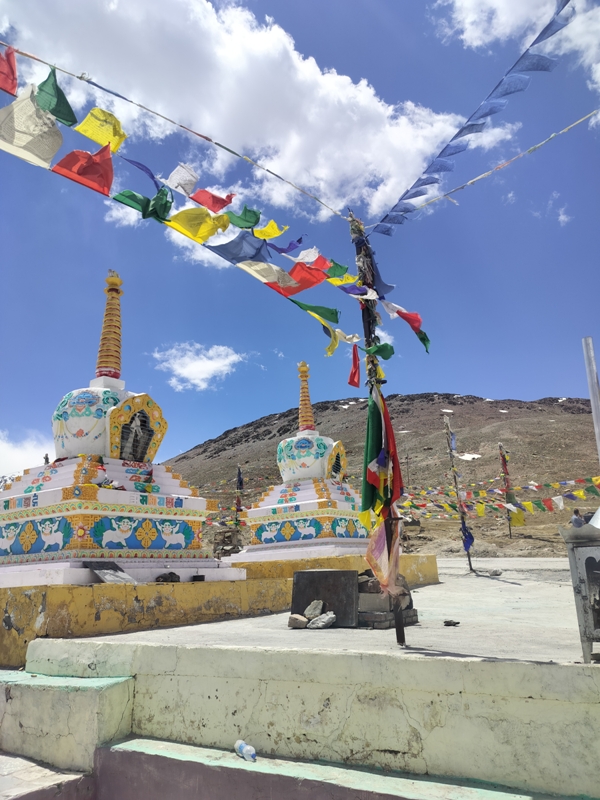
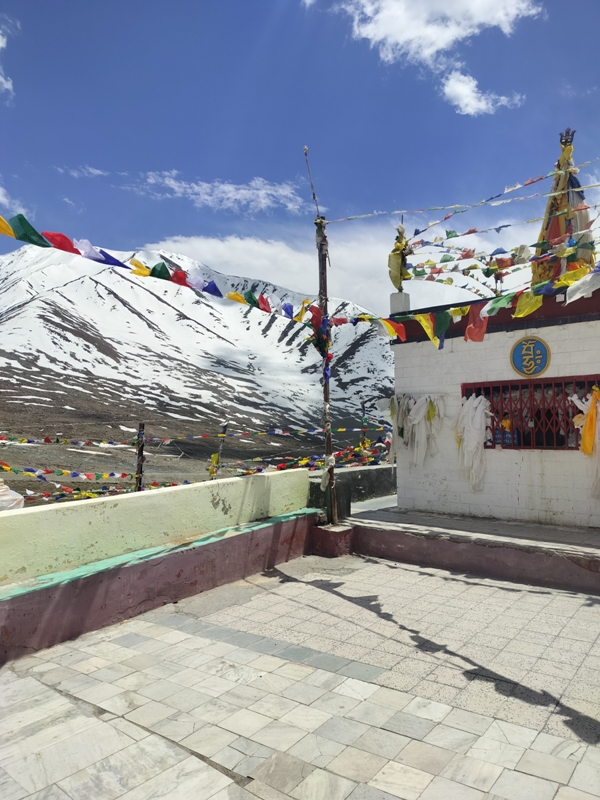

We slowly walked around the shrines to pay our respects and seek safe passage down the other side. Standing amidst the swirling prayer flags, with the deep, echoing silence of the high Himalayas broken only by the whistling wind, we felt an overwhelming sense of reverence and clarity. It is a place where human devotion perfectly balanced the raw, uncensored power of nature.
Framed by Giants: Photographing the Ice Mountains
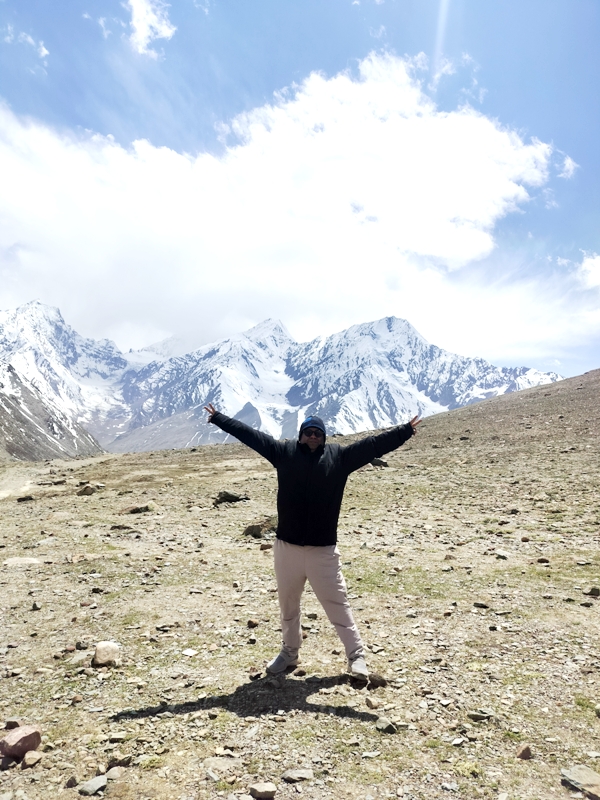
Soon, we turned our eyes outward to the horizon, and the view left us entirely speechless. Kunzum La offers an uninterrupted, jaw-dropping panoramic view of the massive Bara Shigri glacier range. The towering, jagged peaks rose up around us like giant walls of solid white ice and dark granite, the perfect frame for an incredible photoshoot.
The stark contrast between the bright, colorful prayer flags in the foreground, the deep blue high-altitude sky above, and the timeless, frozen walls of ice behind us created absolute magic. Our hands were completely numb, and our lips were chapped from the freezing wind, but as we looked at the previews on our camera screens, we knew these were the images we would look back on for the rest of our lives
Descending to Chandrataal
Clearing Kunzum La didn’t mean the hard part was over; in fact, the real driving test was just beginning. The detour track leading from the main highway down toward Chandrataal is notorious for being one of the most rugged, narrow, and unforgiving dirt tracks in the country.
It is a single-lane ledge carved loosely into the crumbling slopes, with vertical rock walls on one side and a sheer drop down to the valley on the other. Our vehicle crawled at a painstaking low speed, tires slipping over loose gravel and bouncing violently through deep ruts. Every water crossing was a gamble, with freezing glacier melt crashing right over the track. Navigating this tight ribbon of earth, flanked by massive vertical drops on one side and towering walls of rock and ice on the other, makes the journey feel less like a drive and more like an expedition across a frozen, forgotten planet.

It was hours of hard-core driving, before the tight canyon walls suddenly opened up into a wide, sweeping alpine basin, we caught our first glimpse of the basecamp tents.
We had made it..
There were no permanent homes here, no electrical grids, and absolutely no cellular towers. The landscape is a monochrome expanse of grey, jagged boulders that look like they rolled down the mountains yesterday.
Chandrataal
Vehicles are strictly forbidden from going all the way to the shores of Chandrataal in order to protect its fragile ecosystem. Because of this, our journey ended at a designated parking clearing, leaving us to cover the final 1.5 kilometers on foot. Stepped out of that vehicle, was a paradoxical experience, into that wide gravel basin, on one hand was a relief, because hours of driving through that terrain had ensured our nerves were completely frayed, but the moment we touched ground, the cold, thin air of Chandrataal began to bite, aggressively at our lungs.
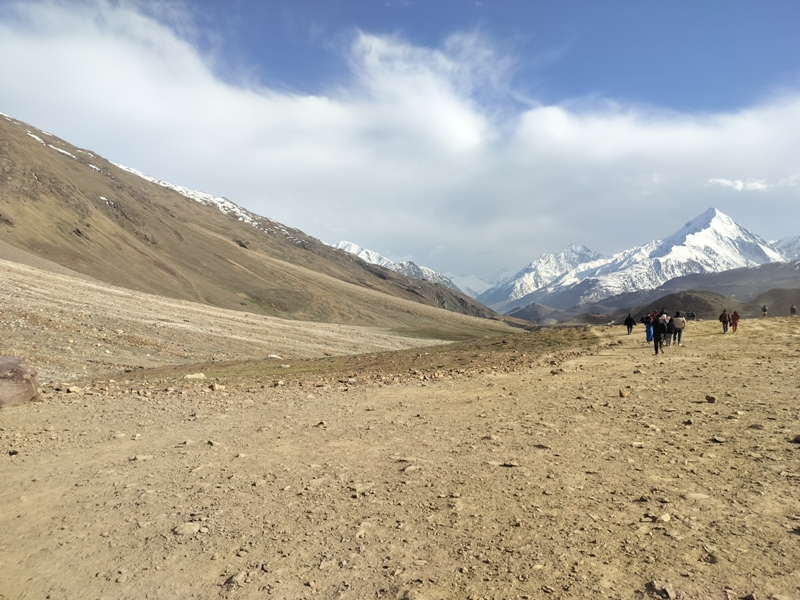
At sea level, a 1.5-kilometer walk is a casual, fifteen-minute stroll. At nearly 14,000 feet, after hours of bone-rattling riding, it feels like an absolute mountaineering expedition. The trail is a narrow, undulating dirt path that winds through vast, desolate meadows hemmed in by massive mountains. There are no steep, vertical climbs, but the invisible enemy here is the sheer lack of oxygen.

Within the first two hundred meters, the raw reality of the altitude cut through our excitement. Our lungs burned, leg muscles felt like lead, and the heart thumped violently. Every minor incline forced us to negotiate with our own body. On one side the chilly mountain air threatened to freeze our respiratory system, thus our body demanded a mask or scarf on our face, on another side lack of breathable air, was silently commanding us to get rid of it. A game of mask on-mask off was going on, throughout the route. We found ourselves walking in a slow, rhythmic crawl—taking ten deliberate steps, stopping to lean on our knees, breathing in the thin, icy air, and repeating the process.
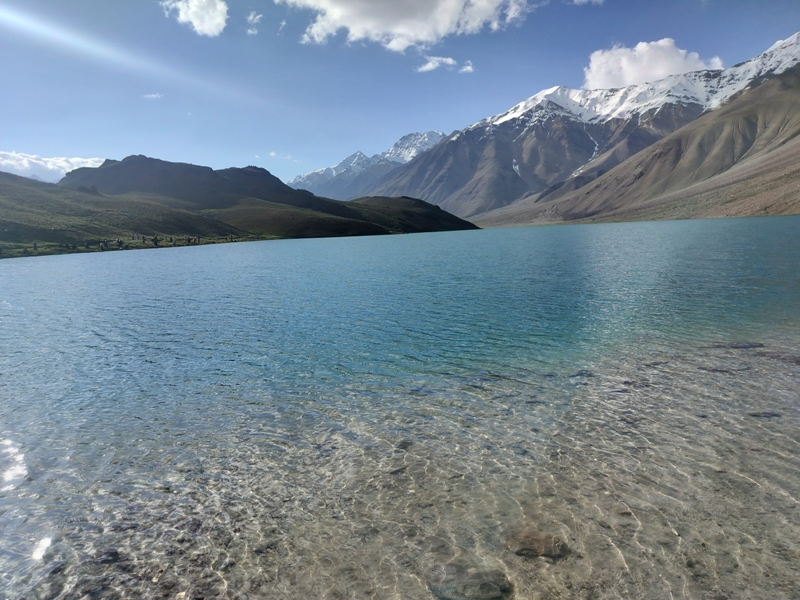
But as we cleared the final ridge, the exhaustion instantly evaporated, replaced by a heavy, breathless feeling of solace. There, tucked perfectly into a bowl of towering, barren mountains, stood Chandrataal – the moon lake.

The water was a brilliant, hyper-saturated shade of turquoise blue, so clear and still that it acted as a flawless glass mirror for the massive, snow-capped peaks surrounding it. There is no roar of waves, no rustle of trees, and no sound of modern city life, only a few equally exhausted and excited tourists like us for company. The lake possessed a deep, almost eerie stillness that commanded absolute silence.
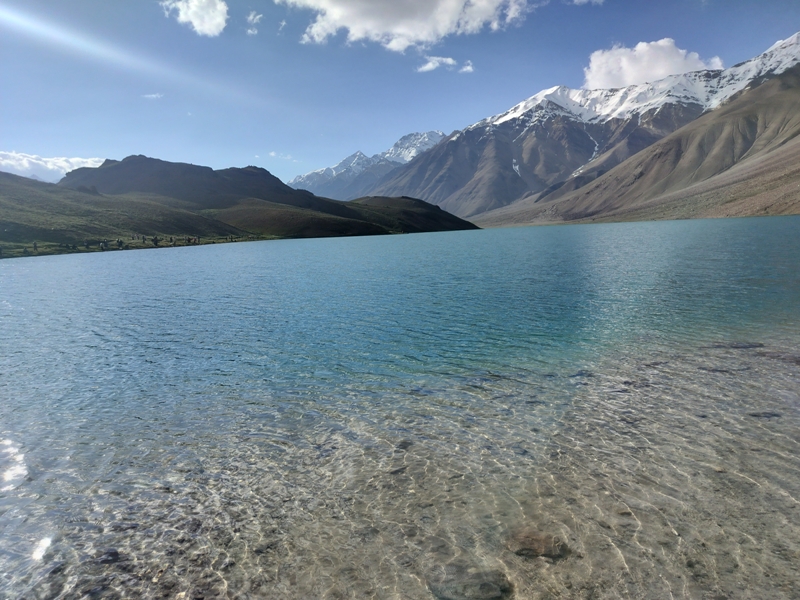
We sat down on the grassy banks, letting the freezing wind whip past our faces, completely mesmerized by the sheer scale of what we were looking at. Pushing our bodies to its physical limits suddenly started making sense.
We had earned our place at the shores of the moon.
Checkout the Day 2. How we experienced Kaza
Go to PostAn unfiltered experience of watching stars while freezing at Chandrataal
Read Day 4
