
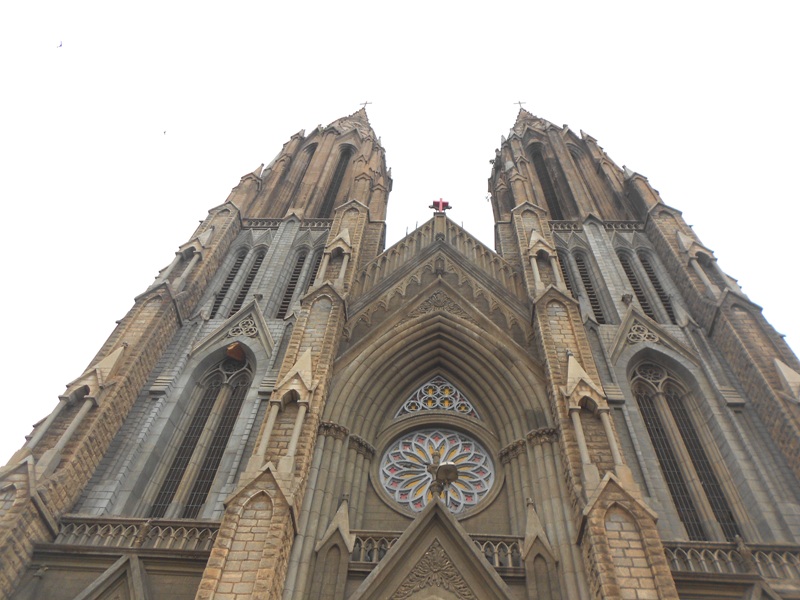
My initial itinerary of Mysore had only a handful of places, like the Amba Vilas Palace, Infosys Mysore Campus and the Brindavan Garden. However it was about to change as soon as our cab entered the city. Two giant spires, with a cross on top of each, protruded out of the city’s skyline.
The colour and architecture of the spires, were radiating history, they looked grand, atleast a century old. It soon created a sense of curiosity inside my mind, and we decided to take a stop at this centuries old church. I leaned forward and asked our cab driver, what church is that tower from? St. Philomina’s he replied.
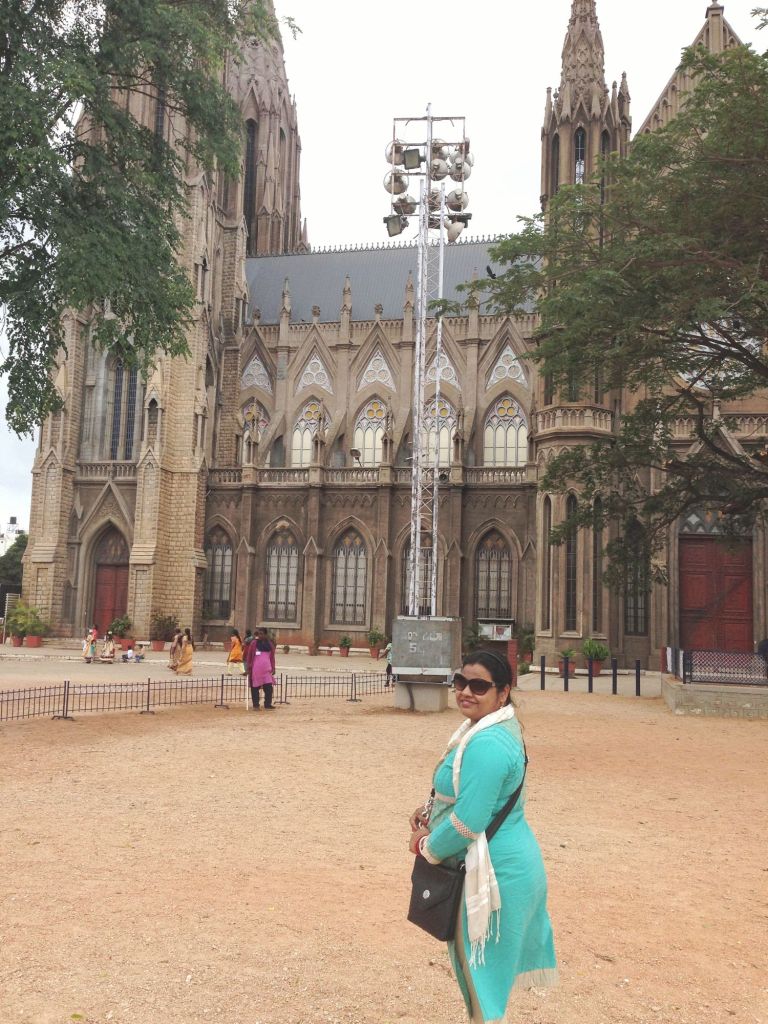
| How to Reach: Bangalore (204 km) and Coimbatore (200 km) are the nearest big city to Mysore. Even though Mysore has a railway station which is 3 KM from the Palace, most tourists prefer to have Bangalore as the first stop. Once in Mysore, finding the Church is not a difficult task at all, as it is located in the Heart of City. |
Photography: As of 2024, Photography inside the church is not allowed. |
Timing: St. Philomena Cathedral Mysore is open 5AM to 6PM. It is illuminated well in the evenings, a real treat to eyes. However if you wish to tour the interior avoid the mass timings. |
- Architecture of St. Philomena’s Church Mysore
- History of St. Philomena’s Church Mysore
- Patron Saint
- Inside the church
- Crypt of St Philomina’s Church
- Conclusion
Architecture of St. Philomena’s Church Mysore
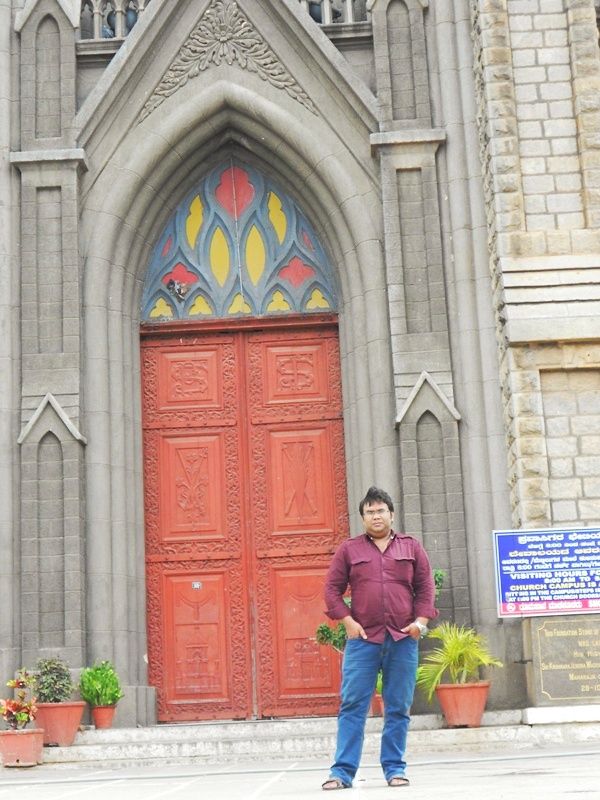
Our decision proved to be correct, as the church, a Neo-Gothic marvel, is a massive structure. It is said that the architecture is inspired by the Cologne Cathedral in Germany. The height of the two towers (church’s spire) is 175 feet, which gives a majestic contribution to the city’s skyline. The 12 feet high crosses on the spires make this church one of the tallest in Asia. There are 3 ornamental doors at the front and several doors on the sides that lead to the prayer hall.

History of St. Philomena’s Church Mysore
In 1799, the capital of the state of Mysore was moved from Srirangapatnam to Mysore city. With this shift, many British soldiers and officers moved to Mysore as well. The then king of Mysore, Maharaja Krishnaraja Wodeyar III allocated a plot of land for these officers, many of whom were devout Christians, to build a church on the Mysore-Bangalore road.
At that time a small church was built, however with time a need for a bigger church was felt. The next ruler of Mysore, Maharaja Krishnaraj Wodeyar IV laid the foundation for a new church on 28 October, 1933. The design for the Church was prepared by Daly, and the church was completed under the supervision of Bishop Rene Fuga.
Patron Saint
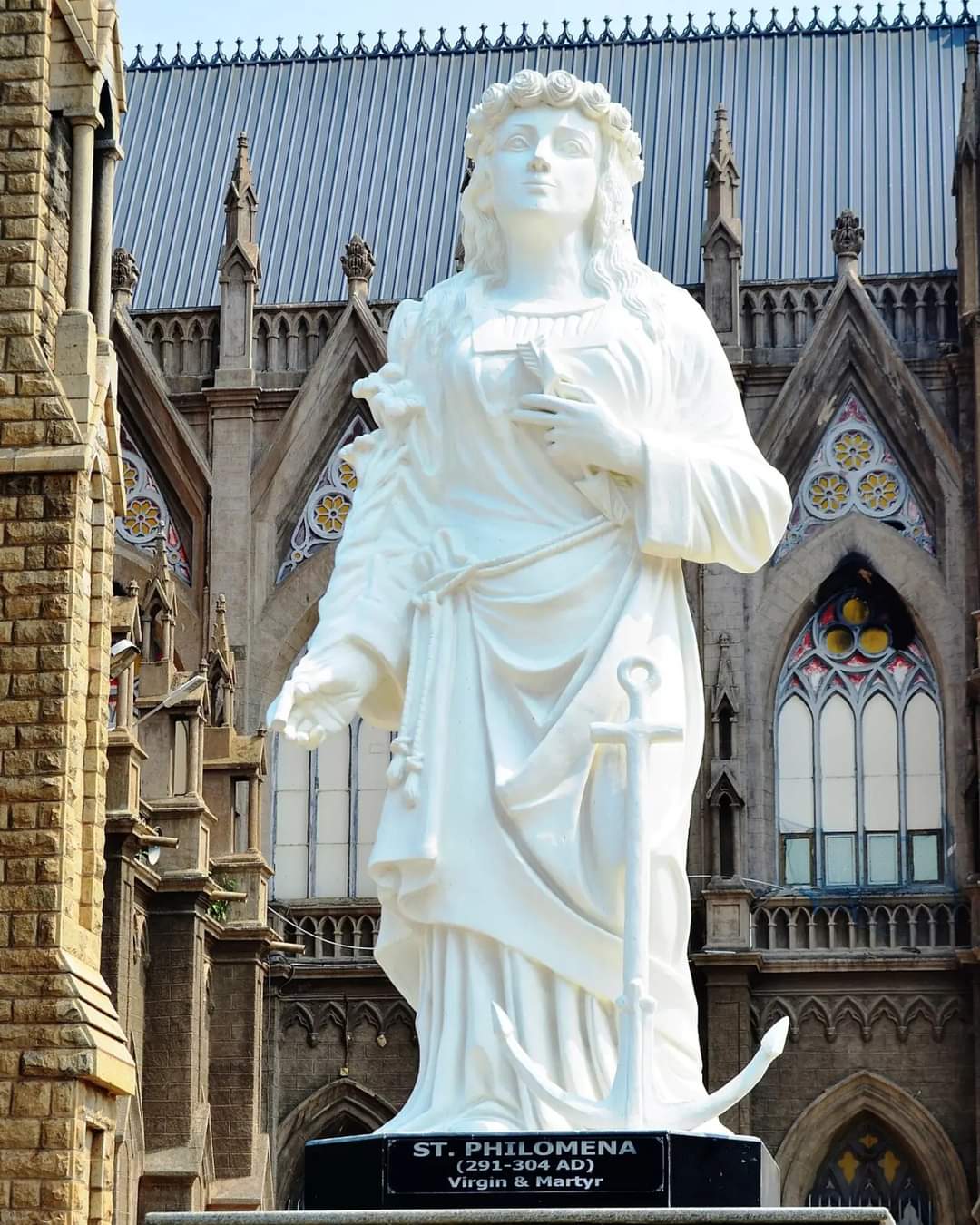
The remains of a teenage girl no older than 14 were discovered on 24 May 1802 in the Catacombs of Saint Priscilla at the Via Salaria in Rome. Inside the tomb, a tile bearing some inscriptions was also found, which loosely translated to ‘Peace with you, Filumena’. Along with these inscriptions, a vessel containing dry blood was also found.
This helped archaeologists to conclude that a Christian named Filumena (Philomena) was buried in the tomb and the vessel containing blood was her relic, evidence of a martyr’s death. Since then sainthood was bestowed upon her and she came to be known as St. Philomena. She is the Patron Saint of this church in Mysore.
The statue of St. Philomena is placed in an underground chamber. Remains of St Philomena are preserved at the cathedral. A piece of her bone is preserved here at the center of a beautiful shield.
Inside the church
As I went inside, a long congregation hall greeted me, which could seat up to 800 people. Two long transepts extended in both sides of the hall. The hall, which is known as nave has multiple columns that culminate into arches. The choir and the altar stood at the junction of these pathways.
It took some time, but I realized that the floor plan of the cathedral resembles a cross. With that hall being that long part, transepts being that arms and the crossing being that altar.
The aisles that are parallel to the nave have many stained-glass images depicting many biblical events; the birth of Christ, the Last Supper, the Crucifixion, and the Resurrection. Since no photography is allowed inside the church hall, I could only capture these from my eyes. These vibrant artworks illuminate the church’s interior, creating a serene and ethereal atmosphere.
The alter contains a statue of St. Philomena, which was brought from France along with an idol of Jesus Christ with his sacred wounds. The Holy Mass is performed daily at the St. Philomena’s Cathedral in Kannada, Tamil, and English in the sanctum sanctorum.
Crypt of St Philomina’s Church
Near the altar, there are steps that lead underground to the crypts. The steps progressed, lights started to fade away, the route becoming darker with every inch I progressed. As I stepped foot inside the actual crypt, the cold stone walls, the dark interiors and thousands of names of people whose remains are housed here, together formulated an eerie experience like I have never felt before.
After walking a few feet, which to me felt like miles, I was on my way out of the crypt. Steps leading up to the ground, with light shining bright, felt so welcoming, that I cannot describe that in words. It felt like coming back to life.
Conclusion
As we left the church and started our journey onwards, I could only Marvel at the intricate nature of the work done on this structure. The 250 years old structure still exhibits grandeur like no other church in India.
 East Indian Traveller